
Systemic Equality: Equal Access, Better Futures
Systemic Equality is A Racial Justice Agenda
Since our nation’s founding, discriminatory policies and laws have created an unequal system in which Black communities have had their civil rights and liberties denied and have been systematically locked out of opportunities in education, housing, employment and more.
Through our Systemic Equality agenda, the ACLU will use nationwide litigation, advocacy, and public education to advance laws and policies rooted in racial equity and end discriminatory policies, laws, and practices that have an outsized impact on Black communities.
The ACLU will also continue to evolve our own culture, systems, and processes to drive progress toward our internal racial justice commitments, including by committing sustained recruitment and hiring efforts to recruit more diverse talent pools, developing initiatives to promote and retain Black leadership, engaging Black-owned and Black-led businesses, and more.
When we have full and equal access to education, jobs, housing, voting rights, and more, better futures are possible.
A Spotlight on Fair Housing

Why Fair Housing is Key to Systemic Equality
Here’s how discrimination continues to impact access to housing today, and why we’re fighting to ensure all people have equal access.

Apply for the ACLU-NBLSA Southern Legal Internship (SLIP) Program
SLIP interns will contribute to crucial campaigns in the issue areas that most affect Black and Brown communities.





How Can We Achieve Systemic Equality?
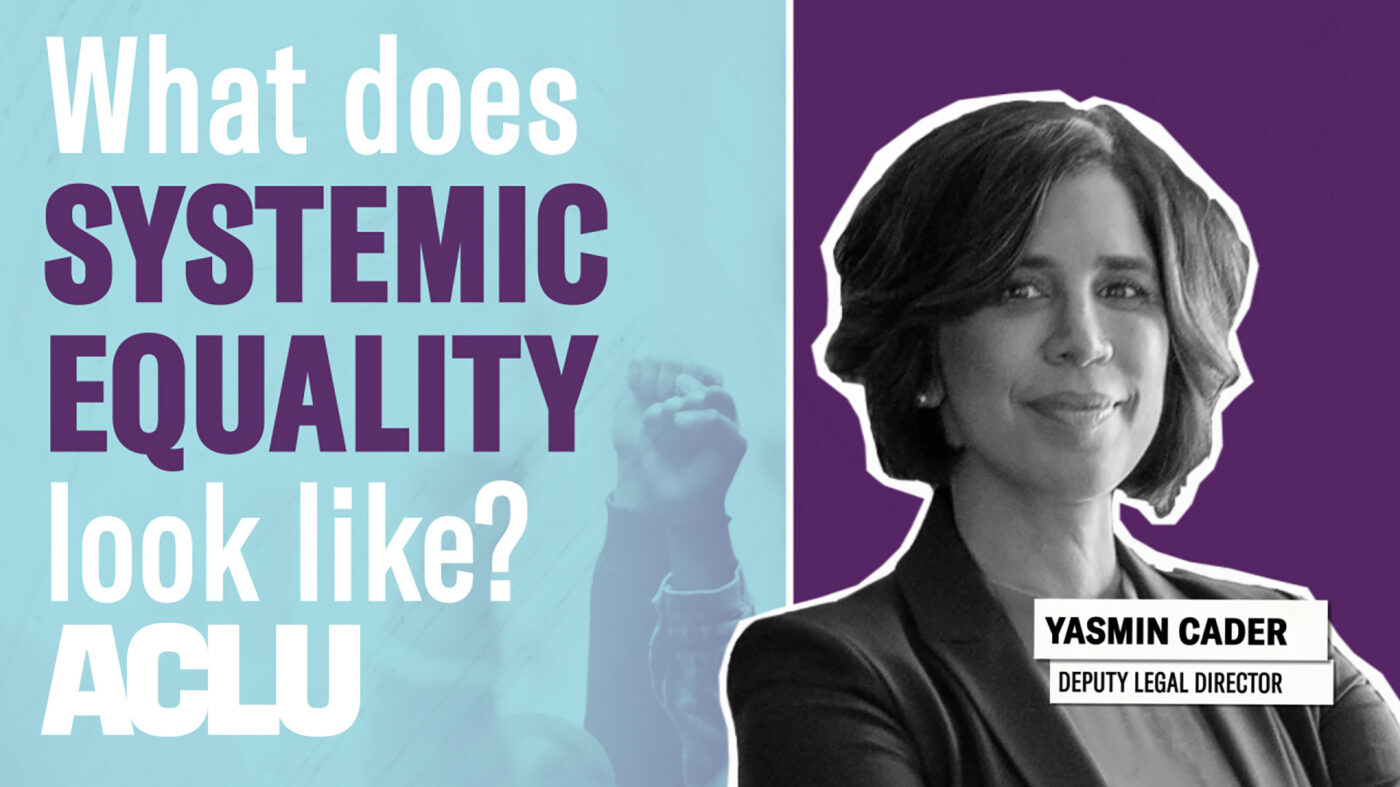
ACLU Deputy Legal Director Yasmin Cader explains what needs to be done in the fight against systemic racial discrimination in order to create a world in which everyone’s civil rights and liberties are recognized.
Related Issues
Related Content
-
Press ReleaseSep 2026

Capital Punishment
Aclu And Aclu Of Mississippi Urge Court To Consider Racial Discrimination In Willie Manning Case. Explore Press Release.ACLU and ACLU of Mississippi Urge Court to Consider Racial Discrimination in Willie Manning Case
JACKSON, Ms. – The American Civil Liberties Union, the ACLU of Mississippi, and partners filed an amicus brief today urging the Mississippi Supreme Court to consider Willie Manning’s claim that prosecutors unconstitutionally excluded Black prospective jurors from his 1994 capital trial. The brief warns that racial discrimination in jury selection was one of several alarming problems that undermine the reliability of Manning’s conviction and death sentence. At trial, prosecutors systematically excluded Black jurors from Manning’s jury, resulting in a nearly all white jury in a county where Black people made up 34% of the population. Prosecutors struck six of the nine Black prospective jurors, for reasons including that the prospective juror read “Ebony” or “Jet” magazines or lived in an “extremely bad neighborhood” – in other words, a predominantly Black neighborhood. Manning’s lawyers challenged the strikes under Batson v. Kentucky, the Supreme Court case that prohibits prosecutors from striking jurors based on race, but the trial judge accepted the prosecutor’s purportedly race-neutral explanations without conducting the proper legal analysis to determine whether they were simply pretexts for discrimination. “Juries are supposed to reflect the communities that they represent, and that’s for good reason: diverse juries deliberate more thoroughly, consider a wider range of evidence, and make fewer mistakes,” said Anna Arceneaux, deputy director of the ACLU’s Capital Punishment Project. “When racial discrimination shapes who can serve on a jury, it undermines the fairness of the entire process for the accused and for prospective jurors alike. In Mr. Manning’s case, the evidence suggests that racial discrimination played a major role in shaping the jury that decided whether he would live or die, and when a person’s life is on the line, the court cannot afford to look past that.” The racial discrimination in jury selection is particularly concerning in this case considering the broader questions surrounding Manning’s conviction and death sentence and known Batson violations in similar cases in Mississippi. Examples of prosecutorial misconduct, the known leading cause of wrongful convictions, run rampant throughout Manning’s case. The same district attorney who prosecuted Manning was responsible for sending several innocent people to prison who were later exonerated. At least twice in the last 7 years, the Supreme Court has sharply condemned Mississippi prosecutors' Batson violations in two cases with striking similarities to Manning’s (Flowers and Pitchford). “To date, the justice system has failed Mr. Manning,” said Ayanna Hill, racial justice attorney, at the ACLU of Mississippi. “We are hopeful that can change, and the Court finds that a lower court’s lack of meaningful review of a prosecutor’s jury strikes undermines the validity of a conviction and death sentence.” The ACLU and ACLU of Mississippi are asking the Mississippi Supreme Court to grant Manning permission to file a post-conviction relief petition to address the prosecution’s systematic and unconstitutional discrimination against Black prospective jurors. The amicus brief is available here. -
Tennessee Supreme CourtAug 2026

Capital Punishment
Free Speech
Associated Press V. Nelsen. Explore Case.Associated Press v. Nelsen
Tennessee's execution policies prevent the press from witnessing critical stages before and after a state execution. However, the public needs to know how they work—or don't work—to participate in informed public debate. The ACLU's State Supreme Court Initiative, alongside the ACLU of Tennessee, filed an amicus brief explaining why a provision in the Tennessee Constitution that guarantees access to government proceedings requires greater press access to executions. -
Press ReleaseMay 2026
Capital Punishment
Statement On Tennessee’s Torturous Execution Attempt Of Tony Carruthers. Explore Press Release.Statement on Tennessee’s Torturous Execution Attempt of Tony Carruthers
NASHVILLE – This morning, Tennessee carried out a botched and torturous attempt to execute Tony Carruthers despite the state’s continued refusal to conduct forensic testing that could prove he was wrongfully convicted. Legal witnesses reported that the state spent more than an hour attempting to set an IV line for the lethal drugs while Mr. Carruthers groaned in pain. After nearly 90 minutes, the execution was halted by a one-year reprieve from Governor Lee. Maria DeLiberato, senior counsel at the ACLU’s Capital Punishment Project had the following statement: “Permitting Tony Carruthers’s execution to move forward without ordering DNA testing was already a profound injustice. Today, that injustice became outright barbaric after Mr. Carruthers was subject to a botched execution attempt. “We are incredibly relieved Governor Lee issued a reprieve. We will fight to ensure that the state never again attempts to put Mr. Carruthers and his family through this torture. More than 130,000 people have signed petitions joining us in this fight, including exonerees who once faced wrongful convictions themselves. “We will also continue to push the governor to use this moment to allow the forensic testing that should have happened long ago. Tennessee cannot continue torturing a man while refusing to answer serious questions about his innocence.” -
Press ReleaseMay 2026
Capital Punishment
Aclu Urges Supreme Court To Stop Tennessee’s Wrongful Execution Of Tony Carruthers. Explore Press Release.ACLU Urges Supreme Court to Stop Tennessee’s Wrongful Execution of Tony Carruthers
WASHINGTON – The American Civil Liberties Union and the ACLU of Tennessee urged the U.S. Supreme Court today to stop Tennessee from executing Tony Carruthers and allow forensic testing that could prove his innocence. Mr. Carruthers is scheduled to be executed tomorrow, May 21, even though he may be innocent. Tennessee is sitting on unidentified DNA and fingerprint evidence that does not match Mr. Carruthers and, if tested, could exonerate him. The ACLU and the ACLU of Tennessee joined Mr. Carruthers’s legal team earlier this year to push for the unmatched forensic evidence to be compared to an alternative suspect identified in 2011 by Mr. Carruthers’s co-defendant. “We are only hours away from the state of Tennessee executing a potentially innocent man while they are sitting on evidence that could prove who really committed this crime,” said Maria DeLiberato, senior counsel at the ACLU’s Capital Punishment Project. “The Supreme Court now stands as the final safeguard between Tennessee and this irreversible injustice. The court must stand firmly on the side of truth, fairness, and the basic principle that we should not take a life while serious questions of innocence remain unanswered and while readily available forensic testing could answer those very questions.” On April 9, the ACLU filed a motion in the Tennessee Supreme Court asking the state to conduct DNA testing that could prove Mr. Carruthers was wrongfully convicted. The testing would likely take about two weeks to conduct. Three weeks after that filing, the Tennessee Supreme Court claimed that the motion was filed in the wrong court, despite clear language in Tennessee law indicating otherwise. They sent the request down to the lower courts only weeks before Mr. Carruthers’ execution date. By the time the case made it to the state’s Court of Criminal Appeals, the Tennessee Supreme Court assumed jurisdiction – putting the request exactly where it started, except five weeks later and only days before the execution. The ACLU is now asking the United States Supreme Court to reverse and reject the Tennessee Supreme Court’s denial of the testing after bouncing his case between courts. “There is no justice in rushing Tony Carruthers to the execution chamber without first testing evidence that could prove his innocence,” said Lucas Cameron-Vaughn, legal director of the ACLU of Tennessee. “Mr. Carruthers was forced to represent himself at trial, and now faces death based on flimsy circumstantial evidence and unreliable witnesses. Forensic evidence the state refuses to test could change everything. The Supreme Court must act now to stop Tennessee from taking an irreversible step while so many critical questions remain unanswered.” On Monday, exonerees, faith leaders, and Tennesseans delivered a petition to Governor Bill Lee, signed by more than 130,000 people from across the country demanding that the governor stop the execution. Tens of thousands of people from across the globe have also called and sent messages directly to the governor’s office. Yesterday, despite these demands, the governor announced he was not planning on intervening to stop the execution. Mr. Carruthers was convicted without any physical evidence tying him to the crime and his conviction and death sentence rested on testimony from jailhouse informants, including one paid by the state who later recanted his statement. Since the first exoneration from DNA in 1989, 614 wrongly convicted people have been exonerated based on DNA tests that proved their innocence. Many of those exonerations involved the same warning signs present in Mr. Carruthers’s case, including unreliable witness testimony and inadequate legal representation.