Defeat, Delay, Dilute: ACLU Versus President Trump

One year ago, President Donald Trump was sworn in for a second term. His administration has created chaos, trampled on our rights, and harmed so many of us. But the ACLU has been fighting back — and winning. Now, we're telling the story of the first year of our fight against the Trump administration’s second term, our lessons learned, and our path forward.

We were prepared for this fight from day one.

Before President Trump was elected, we examined his campaign promises — including those outlined in Project 2025 — and outlined a plan for how we would fight to protect the rights and liberties of all people. We spent months plotting out our litigation and advocacy strategy across the country, building a plan to ensure that cities and states would be a Firewall for Freedom — a shield defending against a federal government attacking civil rights and civil liberties.

Within hours of President Trump's inauguration, it was clear that he and his administration would, once again, test the Constitution and the willingness of our nation’s institutions and people to defend it. But we were ready. The ACLU mobilized our lawyers, advocates, organizers, storytellers, and supporters to delay unconstitutional policies before they took effect, dilute their reach when full blockage wasn’t immediately possible, and defeat them through courts, public pressure, and sustained organizing. In 2025, we took over 230 legal actions against the Trump administration, with remarkable success: 64% of our lawsuits have delayed, diluted, or defeated the Trump administration’s agenda.

But despite everything we’ve accomplished so far, we cannot underestimate the continued speed and ferocity of this assault on civil rights and civil liberties or the impact it will continue to have on us all. And as we enter 2026, the stakes feel as high as ever.

That’s why the ACLU is releasing a report about the first year of the Trump administration, highlighting key lessons learned and laying out our roadmap for the years to come. You can download the full report here: Defeat, Delay, Dilute: ACLU Versus President Trump

What the ACLU does over the next three years and how well we do it will play a role in shaping the course of American history. Because democracy doesn’t defend itself – people do. And together, we will keep showing up.

Fast Facts: the ACLU v. Trump

239

Legal actions taken by the ACLU against the Trump Administration — including lawsuits, records requests, amicus briefs, and agency complaints

64%

Success of ACLU lawsuits in delaying, diluting, or defeating the Trump agenda

51

State laws passed to protect and expand civil liberties and civil rights in the states are part of the ACLU's Firewall for Freedom

Portraits of Protest
Screenshot of Portraits of Protest YouTube video
This embed will serve content from {{ domain }}. See our privacy statement

Safeguarding Free Speech

The Trump administration is openly trying to suppress First Amendment rights and silence opposition through deliberate and unconstitutional intimidation tactics. As the nation's premier defender of free speech and dissent, the ACLU is fighting back.

When the Trump administration sought to detain and deport students and scholars to silence speech in support of Palestinian rights, the ACLU and our partners acted swiftly and were able to help secure the release of Mahmoud Khalil, Rümeysa Öztürk, Mohsen Mahdawi, and Dr. Badar Khan Suri. When the administration bullied ABC into suspending Jimmy Kimmel, we mobilized nearly 500 artists and entertainers and 53,000 Americans to protect free speech — and Kimmel was back on air within hours. And when federal agents and National Guard troops were deployed to cities to go after immigrant communities and protestors, we took legal action, organized our supporters, and brought veterans like Tom Alonzo to Capitol Hill to make their opposition known. Thanks in part to sustained public outcry, President Trump announced on New Year's Eve that he was pulling National Guard troops from Los Angeles, Chicago, and Portland.
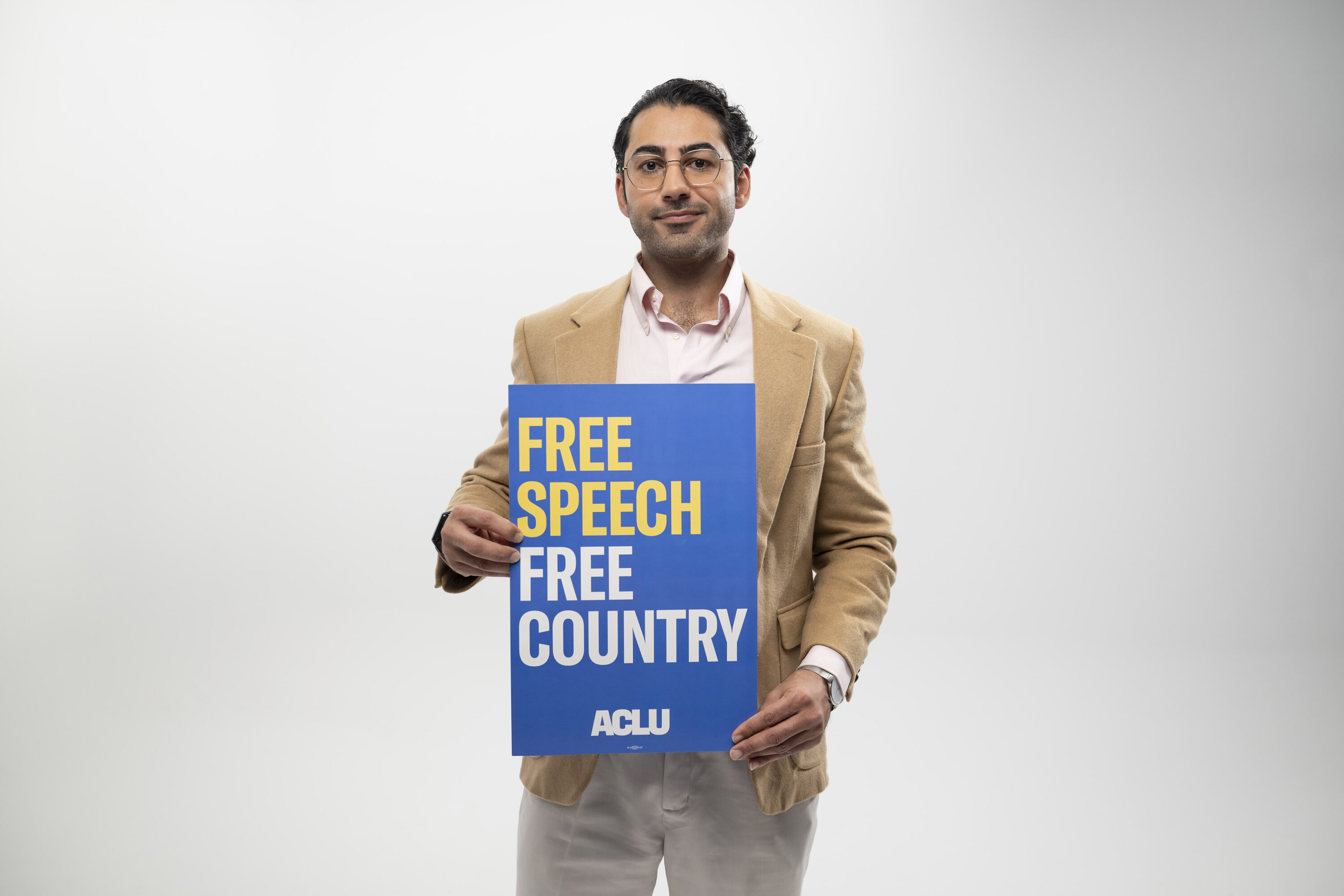
Mohsen Mahdawi holds a sign that reads Free Speech Free Country

Portraits of Protest — Mohsen Mahdawi

When Mohsen Mahdawi went to his naturalization interview, he believed he was close to becoming an American citizen. Instead, he was arrested and detained for more than two weeks in retaliation for his constitutionally protected speech supporting Palestinian rights. But he refused to be intimidated. "Because we have a strong belief in the Constitution," Mohsen said, "there is no fear that can shake us."

Mohsen's case — and the cases of all the students and scholars detained by the Trump administration for their Constitutionally-protected speech — strikes at the heart of First Amendment protections: The government cannot punish people for expressing viewpoints it disagrees with. Working with state affiliates and legal partners, we secured the release of Mohsen and his fellow students and scholars, ensuring they are free and protected from immediate deportation while we continue to fight their cases in court.

Mohsen's message to President Trump and his administration is simple: He is not afraid of them. "I will continue to build community," Mohsen told us. "I'll continue to march in the streets. And I will continue to not be afraid."

Mohsen's case — and the cases of all the students and scholars detained by the Trump administration for their Constitutionally-protected speech — strikes at the heart of First Amendment protections: The government cannot punish people for expressing viewpoints it disagrees with. Working with state affiliates and legal partners, we secured the release of Mohsen and his fellow students and scholars, ensuring they are free and protected from immediate deportation while we continue to fight their cases in court.

Mohsen's message to President Trump and his administration is simple: He is not afraid of them. "I will continue to build community," Mohsen told us. "I'll continue to march in the streets. And I will continue to not be afraid."

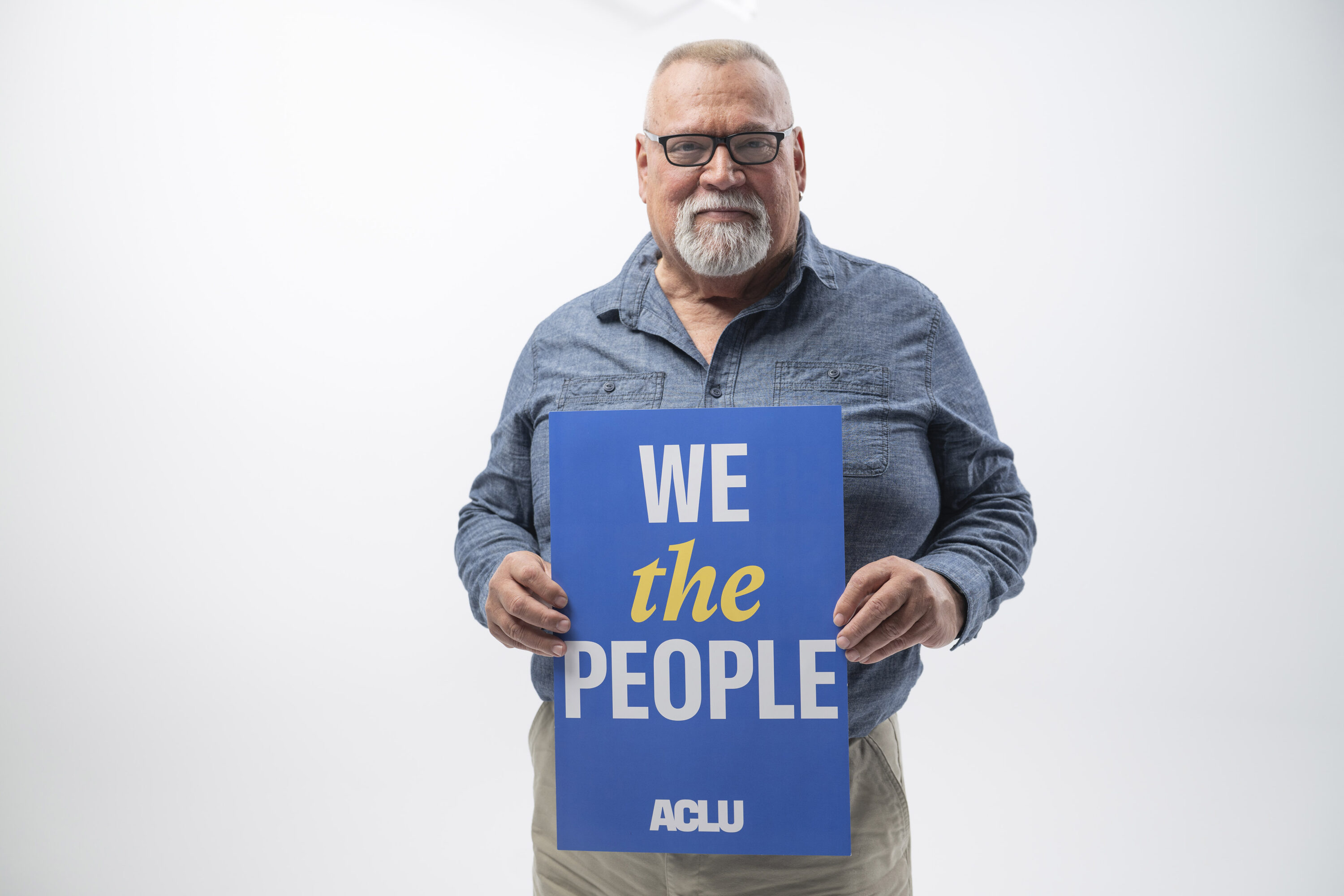
Tom Alonzo holds a photo that says We The People.

Portraits of Protest — Tom Alonzo

Tom Alonzo is an Air Force veteran and LGBTQ+ advocate in Kansas. After President Trump was sworn in for his second term, Tom watched the politicization of our troops, their deployment into American cities, and the treatment of transgender military service members with increasing concern. So, he joined the ACLU and his fellow veterans in October to bring a message to Congress: "Our federal troops do not belong in the streets. They do not belong policing civilians."

As the Trump administration continued its efforts to sow fear and consolidate their power by deploying federal agents and National Guard troops to cities across the country, the ACLU and our affiliates responded with a coordinated strategy combining litigation with organizing, advocacy, and public pressure. Over 400,000 ACLU supporters nationwide took action with us to challenge the administration's deployments. More than 80,000 people joined us for Know Your Rights trainings to learn about their legal protections and prepare for protests. And we brought Tom and his fellow veterans from across the country to Capitol Hill to meet with more than 40 congressional offices, sharing their stories to urge Congress to stop President Trump's militarization of American cities.

Tom knows that this fight can be discouraging at times. "I’m just a person that loves his state in spite of the people that run it don’t love all of us," he told us. And yet, he believes that every person has a role to play in the fight to defend our civil rights and civil liberties. "We’re capable of greatness and we’re capable of compassion."

As the Trump administration continued its efforts to sow fear and consolidate their power by deploying federal agents and National Guard troops to cities across the country, the ACLU and our affiliates responded with a coordinated strategy combining litigation with organizing, advocacy, and public pressure. Over 400,000 ACLU supporters nationwide took action with us to challenge the administration's deployments. More than 80,000 people joined us for Know Your Rights trainings to learn about their legal protections and prepare for protests. And we brought Tom and his fellow veterans from across the country to Capitol Hill to meet with more than 40 congressional offices, sharing their stories to urge Congress to stop President Trump's militarization of American cities.

Tom knows that this fight can be discouraging at times. "I’m just a person that loves his state in spite of the people that run it don’t love all of us," he told us. And yet, he believes that every person has a role to play in the fight to defend our civil rights and civil liberties. "We’re capable of greatness and we’re capable of compassion."


Protecting Immigrants' Rights

On his very first day back in office, President Trump began to issue executive orders aimed at dismantling immigrants' rights and due process, striking simultaneously at birthright citizenship, asylum, and any semblance of fairness in the deportation process. The ACLU immediately sprang into action. Last year, we filed 106 lawsuits to protect immigrants' rights, with a 69% success rate in delaying, diluting, or defeating Trump's immigration agenda. We also rallied our allies in Congress to stand firm against the administration's efforts.

We also worked to educate our community about their rights — and how to protect the rights of others. Over 84,000 people attended ACLU-led Know Your Rights trainings, preparing them for protest activations and what to do if confronted by ICE in their own communities.

Maribel Hernandez Rivera holds a sign that says Know Your Rights.

Portraits of Protest — Maribel Hernández Rivera

Maribel Hernández Rivera, the National Director of Immigrant Community Strategies at the ACLU, knows firsthand what it feels like to think that you could be deported at any time. Maribel came to the United States as a thirteen-year-old and was undocumented. "I thought that at any point they could take me away and nobody would care," she said. "So it's really important that people know that the Constitution protects all of us, whether we are citizens or not; documented or undocumented."

That experience as an undocumented child inspired Maribel to help her community. Today, Maribel leads the Know Your Rights work at the ACLU, empowering others with the knowledge to protect and defend their rights and the rights of others. As she says, "One of the best ways to defend our rights is by exercising our rights."

Over 84,000 people attended ACLU-led Know Your Rights trainings, and the ACLU and our affiliates have distributed millions of Know Your Rights cards. And for those who are afraid to speak up because they are vulnerable, Maribel has a message: "I want them to know that we got them."

That experience as an undocumented child inspired Maribel to help her community. Today, Maribel leads the Know Your Rights work at the ACLU, empowering others with the knowledge to protect and defend their rights and the rights of others. As she says, "One of the best ways to defend our rights is by exercising our rights."

Over 84,000 people attended ACLU-led Know Your Rights trainings, and the ACLU and our affiliates have distributed millions of Know Your Rights cards. And for those who are afraid to speak up because they are vulnerable, Maribel has a message: "I want them to know that we got them."


Defending Equal Protection Under the Law

The Trump administration has censored academic discussions about race and gender, abandoned civil rights enforcement on behalf of historically marginalized groups, and used funding cuts and sweeping purges of federal grants to impose an ideological agenda. And on his very first day back in office, President Trump launched a ruthless agenda attacking transgender people.

The ACLU is fighting to ensure the promise of equal justice is a guaranteed reality, not a selective privilege. When President Trump signed an executive order directing federal agencies to withhold funds from medical providers and institutions that provide gender-affirming medical treatments to anyone under 19 years old, we challenged and blocked the order in court. When President Trump signed an executive order directing the State and Homeland Security Departments to require identification documents, such as passports and visas, to reflect sex assigned at birth, we filed a lawsuit alongside our partners and clients — including Zaya Perysian — to challenge the order. And we will continue fighting to protect the freedom of all people to live authentically.

Zaya Perysian holds a sign that reads Trans People Belong

Portraits of Protest — Zaya Perysian

Zaya Perysian never expected to have to fight the federal government just to be recognized as herself. But when President Trump signed an executive order denying transgender people accurate identification documents, she joined the ACLU and sued the Trump administration. As Zaya says: "The Trump administration does not have absolute power like they pretend to have."

Thanks to our lawsuit, we initially secured nationwide relief that allowed many transgender and intersex people to access accurate passports. But in a heartbreaking setback, the Supreme Court later stayed the injunction, permitting enforcement of the policy. We will continue fighting as this case returns to the lower courts.

And Zaya won’t stop fighting either. "One of the strongest forms of resistance is existing," she told us. "I'm going to exist. I'm going to be a diva. I'm going to be a doll." And she will continue to be a voice for her community.

Thanks to our lawsuit, we initially secured nationwide relief that allowed many transgender and intersex people to access accurate passports. But in a heartbreaking setback, the Supreme Court later stayed the injunction, permitting enforcement of the policy. We will continue fighting as this case returns to the lower courts.

And Zaya won’t stop fighting either. "One of the strongest forms of resistance is existing," she told us. "I'm going to exist. I'm going to be a diva. I'm going to be a doll." And she will continue to be a voice for her community.


Building Power

To confront this administration's aggressive agenda, we're organizing at every level — partnering with allies nationwide and working with our state affiliates to defend civil liberties and civil rights. And we are not in this fight alone. We are joined by a growing community of activists and volunteers like Suzanne Potts who believe our collective power can turn the tide.

In 2025, the ACLU played a key role in building the national infrastructure for protest by establishing shared standards for safety and nonviolence and equipping protesters with the tools and confidence to safely, peacefully, and joyfully exercise their First Amendment rights. In June, we co‑sponsored the nationwide No Kings protests with Indivisible and a broad coalition of labor, environmental, and human rights organizations. More than five million people rallied at over 2,100 events. By October, the No Kings rallies grew even larger, peacefully bringing together over seven million people across 2,700 events. It was one of the largest single-day political protests in U.S. history, a resounding affirmation that no one is above the Constitution.
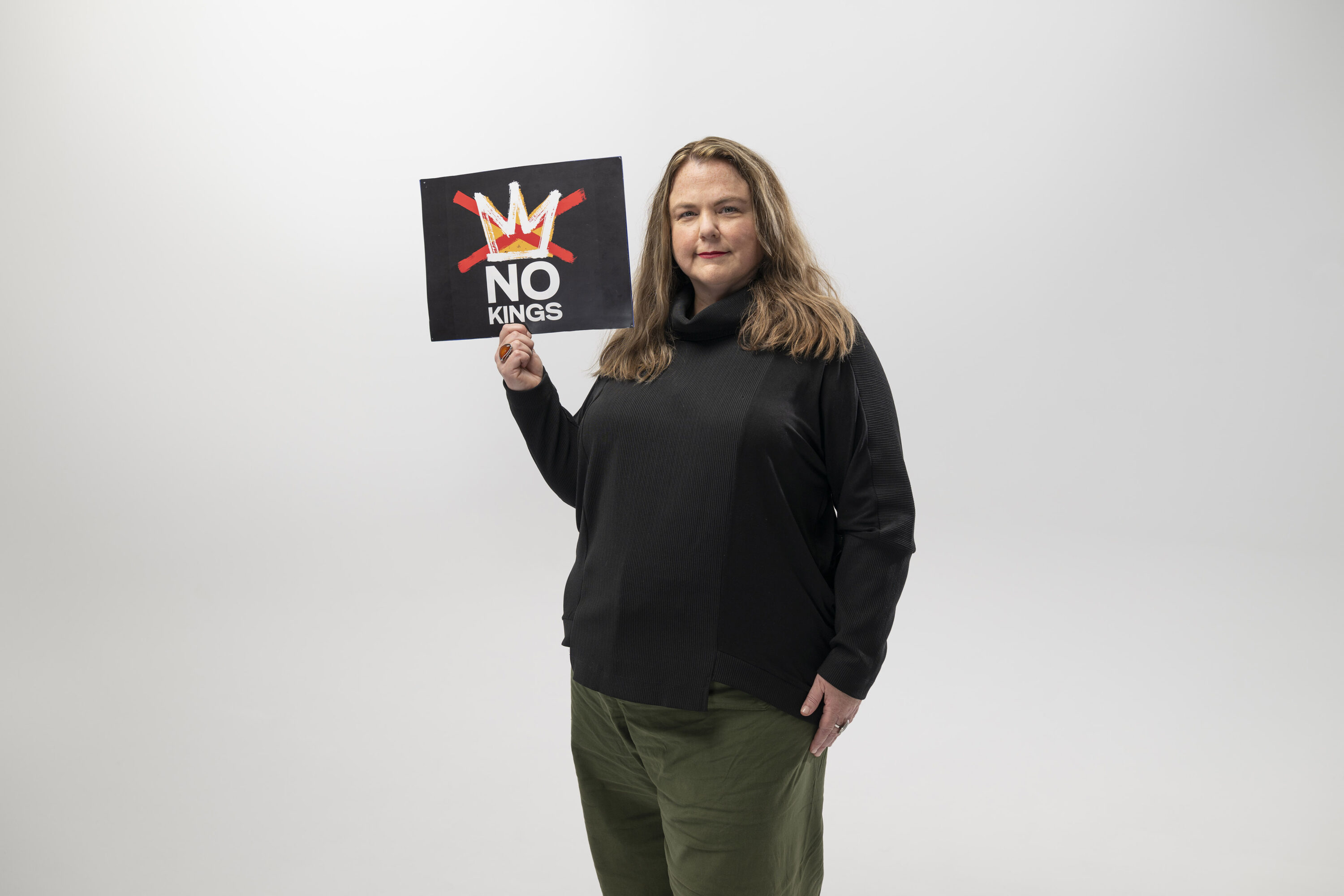
Suzanne Potts holds a sign that says No Kings

Portraits of Protest — Suzanne Potts

Just 20 people attended Suzanne Potts' first protest in 2025. That movement grew to 300 people. Then 2,500 people. By the time of the October No Kings protest, Suzanne and her Savannah Indivisible co-chair, Suzanne Moccia, had organized a rally with over 5,000 people in Savannah, Georgia. "One person can make a difference," Suzanne said. "It’s scarier when you're not doing anything. Taking action will alleviate some of that fear. This is our North Star."

The Trump administration thrives on fear, silence, and divisiveness. But these moments of collective resistance shift the balance of power back to the people. "We must assert our First Amendment rights to show that fear will not win," Suzanne told us. "We need to be out there, shouting and screaming, letting people know that we will not be silenced."

While dedicated organizers like Suzanne made the historic protests in 2025 possible, they didn’t do it alone. Suzanne credits the work of Savannah Indivisible's steering committee, their volunteers, and the coalitions of local and national organizations that have come together to make these protests possible: "We were able to take risks and think a little bigger. That was solely because of the partnership with the ACLU."

The Trump administration thrives on fear, silence, and divisiveness. But these moments of collective resistance shift the balance of power back to the people. "We must assert our First Amendment rights to show that fear will not win," Suzanne told us. "We need to be out there, shouting and screaming, letting people know that we will not be silenced."

While dedicated organizers like Suzanne made the historic protests in 2025 possible, they didn’t do it alone. Suzanne credits the work of Savannah Indivisible's steering committee, their volunteers, and the coalitions of local and national organizations that have come together to make these protests possible: "We were able to take risks and think a little bigger. That was solely because of the partnership with the ACLU."

Learn More About the Issues on This Page